The season planning guide: which race, which month, which order?
RaceTurkiye
August 22, 2026 · 18 min read
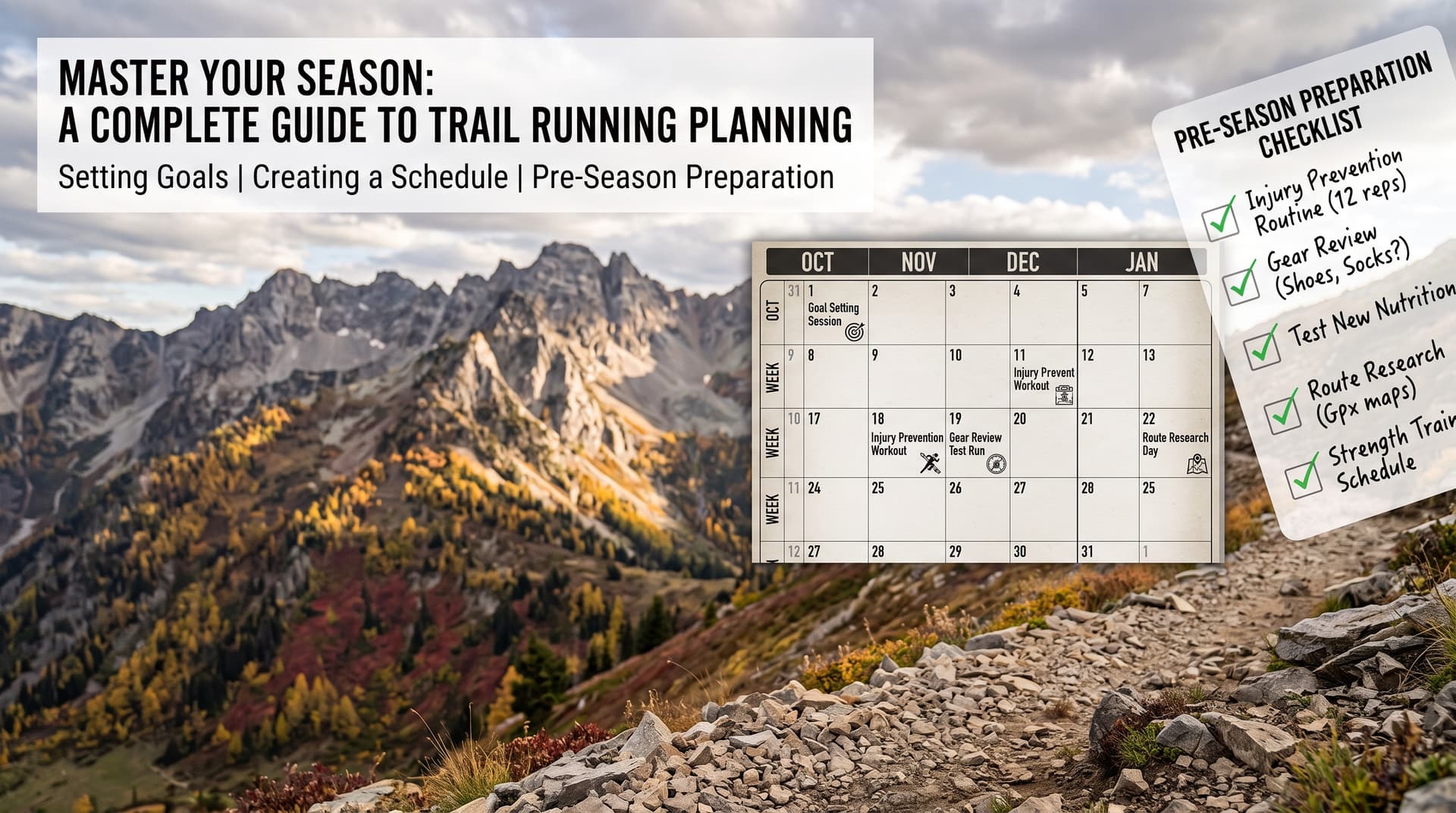
It is early January and the year is wide open. You have your eye on a trail race, you are thinking about the marathon your club is going to, and there is the half you missed last year. You save all three, separately. Then September arrives and you notice that two of them fall on the same weekend, one closed registration weeks ago, and you did not race at all between April and August. Each decision made sense on its own. Together they were not a season plan — they were a pile of coincidences.
Planning a season means answering three questions in order: which race am I ready for, which month should I run it in, and how do I arrange these across a year. This guide covers all three — the first two with a difficulty measure and five years of weather data, the third by walking through the season planner. It is not a training plan; it is about what to base the decisions on.
Read it in order, or jump straight to the part you need.
Part one: which race am I ready for?
You have been running regularly for six months and the 10K feels comfortable. A friend says "come and sign up for this mountain race, it's only 21 kilometres." The same weekend there is a road half marathon — also 21 kilometres. On paper they are the same distance. So why is one a sensible next step and the other possibly eight hours on your feet?
Because distance alone does not tell you how hard a race is.
How difficulty is measured: km-effort
The standard measure in trail running is km-effort. The formula ITRA (the sport's international body) uses is surprisingly simple:
km-effort = distance (km) + climb (m) / 100
Every 100 metres of ascent counts as one extra kilometre of running. A 21-kilometre trail race with 900 metres of climbing comes to 21 + 9 = 30 km-effort. The same 21 kilometres as a road half marathon with 150 metres of climbing comes to 22.5.
Worth being precise about one thing: this is ITRA's own official calculation, and it ignores descent. In reality descending tires you too — on long downhills that is where most of the damage happens — but ITRA's methodology treats descent as effectively free. The site's Course Analysis tool therefore uses an extended version that does count descent, and the two tools can give different numbers for the same route. That is not an inconsistency but a deliberate choice: one is ITRA's official figure, the other a more realistic reading.
Race types, ranked by difficulty rather than distance
10K · +50m
Within reach once you can run 40–50 minutes without stopping, three times a week.
21K · +150m
Once your long runs reach 14–16 km. Twice the distance but the same category: on the road, climbing adds almost nothing.
21K · +900m
The same 21 km, one category up. Power-hiking a climb and controlling your feet on a technical descent are separate skills.
42K · +300m
After a comfortable half marathon, and after holding a steady weekly volume for months.
50K · +2000m
The same category as a marathon but a different race: here fuelling, kit and a walking strategy come before pace.
82K · +5600m
One of the hardest bands in the catalogue. Usually reached after a few seasons at shorter ultra distances.
The most instructive rows are the middle pair. The same 21 kilometres: XXS on the road, XS in the mountains. One rung up.
And the difference is not only in the number. A mountainous 21K asks for different work: you do not run the steep climbs, you hike them — which is normal and correct. Placing your feet on a technical descent and holding your balance on loose rock are separate skills, and they do not develop by running on flat roads. A distance you finish in four hours on the road can take seven in the mountains.
So "the next step" does not have to mean "a longer distance". For someone racing 21K on the road, a 21K in the mountains is a genuine step up without adding a single kilometre.
What is in our catalogue?
- XXS45
hardest: Ultra Abant — Forest Run 18K (18K, +660m)
- XS13
hardest: Veloturk Gran Fondo Çeşme — Çeşme (Kısa) 41K (41K, +382m)
- S27
hardest: Veloturk Gran Fondo Çeşme — Toyota Hybrid (Orta) 67K (67K, +787m)
- M14
hardest: Gran Fondo Başkent — 90K Uzun Parkur (90.61K, +1237m)
- L10
hardest: Efes Ultra — Ephesus Ultra Trail 120K (120K, +3275m)
- XL2
hardest: İznik Ultra Maratonu — 160K İznik Ultra (160K, +4740m)
- XXL0
Of the catalogue's 486 distances, 111 carry an elevation figure and only those can be placed.
The distribution of races in Türkiye favours people starting out: short road races and mid-length trails are plentiful, and there is almost nothing in the top categories. You will not run short of options on the first few rungs.
One honest limit here: not every distance in the catalogue has an elevation figure. A race whose climbing is unknown cannot be placed in a category — looking at the distance and guessing would put it in a class it has not earned. The note under the chart says how many distances could be counted.
Making the decision yourself
A better version of "am I ready?"
"Am I ready for a 21K?" is too broad to answer. A more useful question: how long can I currently keep moving without stopping?
A race's duration tells you more than its distance. A mountainous 30 km-effort race takes most amateurs four to six hours. If your longest run is two hours, the problem is not the distance — it is staying on your feet three times as long, eating, drinking and managing your own morale.
Look at the climbing before the distance
The first number to read on a race page may not be the distance. A figure like "+1200m" stays abstract for someone who has never run in the mountains. Concretely: every 100 metres of climb is one more kilometre of running, by the formula. So +1200m means adding 12 kilometres to the race.
More useful still is dividing the climb by the distance. Twenty metres per kilometre is nearly flat. Fifty metres per kilometre is distinctly hilly. Above seventy metres per kilometre is real mountain terrain, and you will be hiking more than running.
On a new rung, let the goal be finishing
Setting a time target the first time you step up a category means testing two unknowns at once. If the distance or the terrain is new to you, the aim that day is to finish — and you come away with a reference to compare against when you return to the same race.
Look for an intermediate step rather than skipping one
Going straight from a 10K to a mountainous 50K is technically possible and needlessly risky. The intermediate steps exist and the catalogue has plenty of them: a road half marathon, then a gently hilly 21K trail, then something in the 30–35K range. Each rung teaches you what the next one will ask for.
Arranging those steps across a year is what part three is about.
Part two: which month should you race?
You have decided which race to run. The next question is which week of the year to put it in — and that matters more than most people expect.
Look at the Turkish marathon calendar and one thing stands out: almost no long road races in July and August, and dozens crammed into October. That is not a coincidence. What follows rests on the real race-day weather stored on the site: temperature, rain and wind records from 2021 to 2025 for the days the catalogue's races were actually held.
How temperature affects performance
Temperature is the best-documented environmental factor in endurance sport. Marathon times come out fastest at roughly 5–10°C and slow measurably above about 15°C. The reason is simple: the heat you generate while running has to leave your body, and when the air is warm that job falls harder on your circulation — blood sent to the skin is blood not sent to the muscles.
The important detail is that the threshold moves with distance. A marathon carries the cumulative load of producing heat for four hours; a 10K does not. So the site's weather scoring uses a different ideal temperature per distance:
- 30K and above (marathon, ultra): 7°C
- 15–30K (half marathon): 10°C
- Under 15K (10K and shorter): 12°C
Which means there is no single answer to "the best month". The same weekend can be too warm for a marathon and ideal for a 10K.
What race days actually look like in Türkiye
Mean race-day temperatureIdeal for marathon and up: 7°CIdeal for 10K and under: 12°C
- J—no data
- F—no data
- M—no data
- A18.6°2 races
- M20.6°1 race
- J—no data
- J—no data
- A24.6°15 races
- S21.9°22 races
- O18.1°33 races
- N15.3°22 races
- D10.3°6 races
Months with a dashed outline rest on fewer than three races: their average is one race's weather, not a month's.
The chart has two vertical lines: the marathon ideal and the short-distance ideal. Autumn is the only long stretch that passes between them — and that is the physical reason the race count explodes in October.
The August figure explains the absence of long road races in summer. The mean race-day temperature sits far above the marathon ideal. No races in August is not an oversight by organizers; it is what the climate imposes.
One limit to keep in mind while reading it: months with a dashed outline rest on fewer than three races. February, April and May are like that — their average is one race's weather, not a month's. The catalogue holds very few events in those months, and claiming more would not be honest.
Which races get the best conditions?
| Race | Month | Observed | Ideal | Score |
|---|---|---|---|---|
| 8. Gazi Yarı Maratonu21K | Nov | 10.0° | 10° | 100 · Excellent |
| Sagalassos Sky Ultra42K | Nov | 8.0° | 7° | 92 · Excellent |
| TOŞ 1. Kademe Yarışları - Tokat10K | Nov | 9.6° | 12° | 88 · Excellent |
| 24 Kasım Öğretmenler Günü Koşusu10K | Nov | 14.4° | 12° | 88 · Excellent |
| KeşifRun Nilüfer10K | Nov | 13.7° | 12° | 86 · Excellent |
| Soli 10K10K | Nov | 16.2° | 12° | 85 · Excellent |
| Bosphorun Quarter Marathon - Bebek/Beşiktaş11K | Oct | 14.5° | 12° | 83 · Good |
| Caddebostan Cumhuriyet Koşusu10K | Oct | 15.6° | 12° | 83 · Good |
The score measures weather only: temperature, rain and wind. It says nothing about how hard the course is, how well the event is run, or how much you will enjoy it. Perfect weather on a mountainous course does not make the race easy.
Each row prints both the observed temperature and the ideal it is being judged against. That is deliberate: if you cannot check a score, you have no reason to trust it.
Applying this to your own plan
Choose your goal race around the climate, not against it
If you are attempting a marathon personal best, the October–November window is physically the most favourable in Türkiye. Running that same marathon in June means a slower time at identical fitness — not from a training deficit, but from the weather.
That is not a prohibition. Summer races are run with a finishing goal, a different pace and a more serious hydration plan. Just go in knowing they are two different races.
In a summer race, aim for a strategy rather than a time
If you are racing in heat, adjusting your expectations beforehand beats adjusting them at kilometre 30. A fluid and electrolyte plan, light clothing, a deliberately slow opening pace — these are the normal furniture of a hot-weather race, not signs of weakness.
An early start is worth a whole month
A daily mean temperature is not the temperature at the gun. An ultra starting at 04:00 in August and a road race starting at 10:00 are racing in two entirely different sets of conditions on the same day. The start time on a race page therefore carries as much information as the average temperature.
Do not overrate rain
The wet-day share in the data is lower than most people expect for most months. And for endurance performance, cool rain is usually less of a problem than warm sun — getting wet does not slow you down, overheating does. Rain's real risks are hypothermia and footing: a wet, windy day on a long mountain race deserves respect, while on a city 10K it is mostly just discomfort.
What this data cannot tell you
To be straight about it, there are things these numbers do not say.
Five years of observation is not a climate average. A single hot October can pull a month's mean upward. That is why the number of races and observations behind each figure is printed alongside it.
Temperature alone is not the whole story either. Humidity can matter as much as heat for endurance performance, and 25°C at 30% humidity is not the same race as 25°C at 80%. Our records include humidity but the scoring leaves it out — because a simple rule you can check beats a sophisticated one you cannot.
And there is only one location per race: each event uses its own coordinates, but temperature can vary along a marathon course. On mountain races a few degrees between summit and valley is normal.
Part three: putting the season together
You know which races you want and roughly which months you want them in. What remains is arranging them across a year — and this is exactly where problems invisible in the first two parts appear: two races landing on the same weekend, an ultra two weeks after a marathon, or a registration deadline missed.
That is what the season planner is for: it looks at everything you have marked as a set and shows you what you cannot see one race at a time.
Why saving races one at a time is not enough
Entering a race is a single decision. A season is the sum of those decisions — and the sum has properties of its own. Two races can each be perfect, and impossible together the moment they land on the same weekend. A marathon can be an excellent goal, and a 50K two weeks later damages both.
None of those properties is visible on any single race page, because there is nothing there to compare against. Only somewhere that looks at the whole year at once can see them.
A crowded season
Six races, four of them inside eight weeks. The rest of the year is empty.
- 50K trail: two weeks after the marathon, far too little recovery
- Half marathon: same day as another race, in a different city
A season with a shape
The same six races. One goal race, with room to recover around it.
- Marathon (goal): the season's goal race, with everything else placed around it
Both rows above hold the same six races. The difference is not how many races there are, or which ones — only where they sit. The top row is not a season, it is a queue. The bottom row is a season with a shape, built from exactly the same races.
Step 1: mark the races
The planner does not fill itself. The plan is fed from each race's own page, which is why it looks empty the first time you open it.
Open a race page (from the home page, or /takvim), find the "Status" dropdown in the sidebar, and pick one of:
- Planned — you are interested, not entered yet. It joins your season and you get warned when registration is closing.
- Registered — you are in. A firmer commitment, drawn as a filled marker on the calendar.
- Completed — you have run it. You can add your finish time and placing.
Just saving a race (the heart) is not enough: that is a wishlist and it does not enter the plan. The distinction is deliberate — if everything you were curious about joined the plan, the plan would become a wishlist and the clash warnings would stop meaning anything.
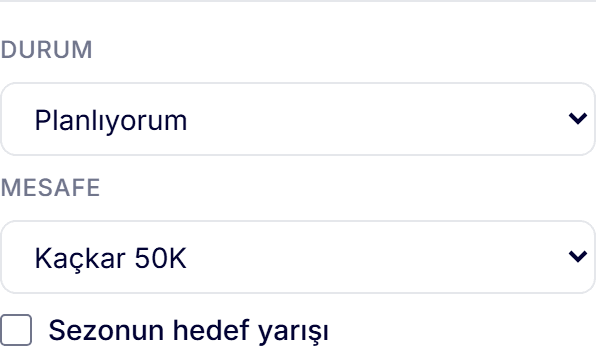
- Status: the race joins your season the moment you pick “Planned” or “Registered”.
- Distance: only appears when the race offers more than one. You can leave it blank.
- Goal race: one per season; mark it and the other races read relative to it.
Step 2: say which distance you entered
If the race offers more than one distance (10K / 21K / 42K), a "Distance" dropdown appears once you set a status. Pick the one you entered.
The field is optional and you can leave it blank. Blank means the calculations assume the longest distance on offer — so a race offering 10K/21K/42K counts as 42K. That is a safe assumption but not yours: if you entered the 10K, the recovery warnings will be needlessly cautious and your season distance will read high.
Two seconds of clicking makes every number on the page actually about you.
Step 3: look at your season
Open My Season from the header (it appears when you are signed in). The page shows:
At the top, any registration about to close. Only for races you marked Planned but have not entered, and only inside a three-week window. A race you are already registered for does not appear, because its deadline is no longer your problem.
Four numbers. Races and distance raced, races and distance still ahead, date clashes, tight recoveries. Raced and upcoming are separate because one "total distance" mixes two different things: kilometres you have run are earned, kilometres you intend to run are still an intention.
A month calendar. Raceless months are drawn, not skipped — the gaps carry information too. Filled squares are races you have entered, outlined ones are planned, struck-through grey ones are already run.
The race order. In date order, each with the gap since the previous race and any warnings.
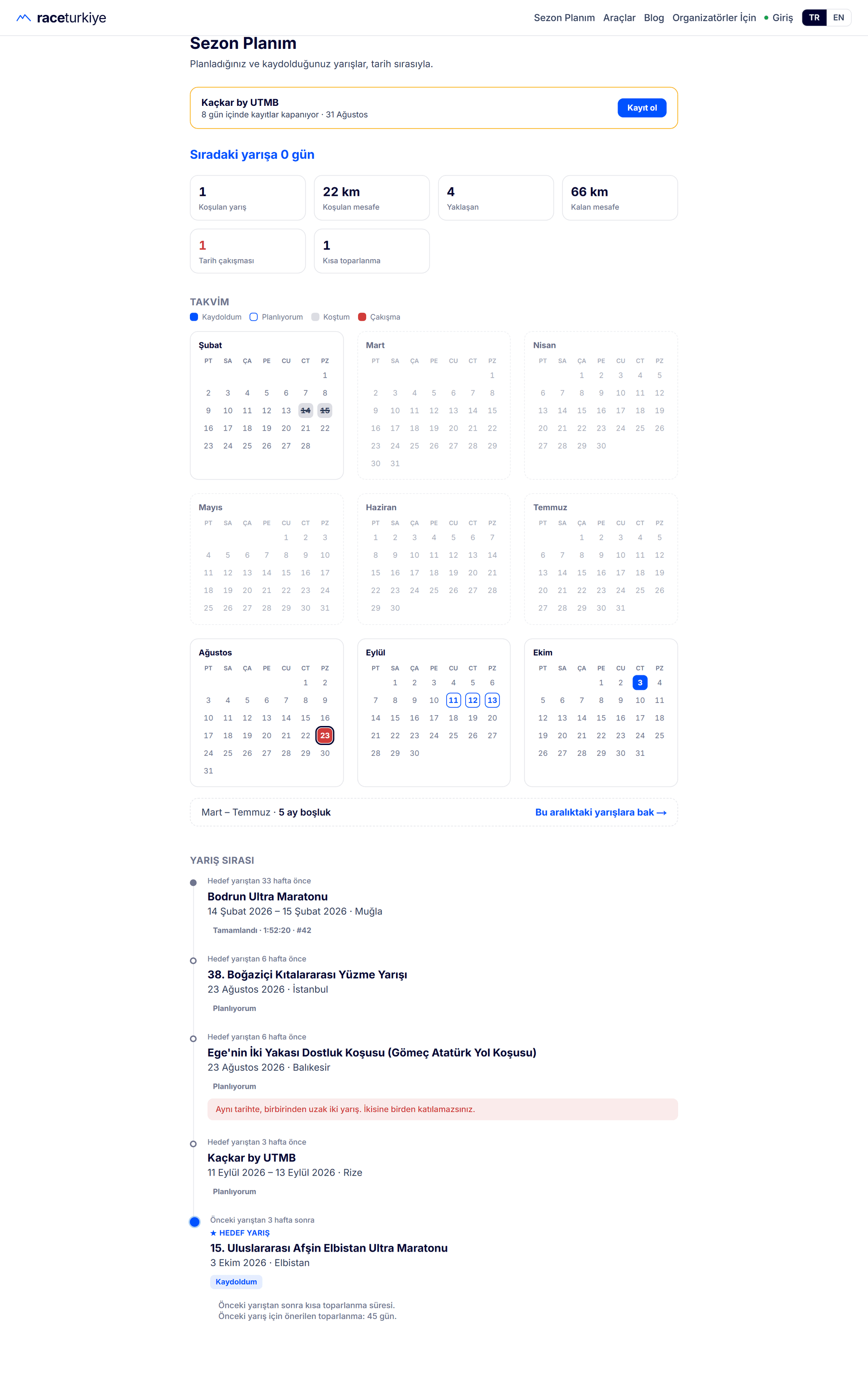
- A raced event is struck through in grey on the calendar, and carries its finish time in the list.
- Two races on one date, far apart, are red: “Date clashes 1”.
- The starred row is the goal race; the others then read as “6 weeks before the goal race”.
- The note under the calendar names a five-month gap and links to races in that window.
Step 4: read the warnings
| What you see | What it means | What to do |
|---|---|---|
| Blocker“Two races on the same date, far apart.” | Two races fall on the same day, more than 150 km apart. You cannot do both. | Pick one and drop the other. |
| Warning“Short recovery window.” | The gap is shorter than the previous race's expected recovery. Not necessarily wrong: a deliberate tune-up race is a real tactic. | Leave it if it was deliberate. If not, move the second race out a week or two. |
| Blocker“Registration closes in X days.” | A race you have planned but not yet entered is about to close registration. | Enter it, or take it out of your plan. |
| Info“N-month gap.” | Three or more months with no race. Not an error: an off-season is a plan too. | If it is an oversight rather than a break, follow the link to races in that window. |
| Warning“~18 October” (a tilde before the date) | The organizer has not announced the date; this is our estimate. Any warning resting on it is provisional too. | Confirm with the organizer before booking travel or accommodation. |
The distinction that matters most: a clash is a fact, a short recovery is a judgment.
A clash is arithmetic. Two races on the same day, more than 150 km apart — you cannot do both, and there is nothing to discuss. That is why it is red.
A short recovery is not like that. Running a short tune-up race two weeks before a goal race is a real and common tactic. The page is not telling you not to do it; it is asking whether you noticed. That is why it is a quieter note and not presented as an error.
You will also notice that two races on the same day in the same city are not counted as a clash: a morning 5K and an evening 10K can be a choice rather than an accident.
Step 5: name your goal race
On a race page, once the status is Planned or Registered, tick "My goal race this season". One per season.
That single mark changes how the page reads. Before it, every row said "7 weeks after the previous race" — true, and useless. After it, rows start saying "6 weeks before the goal race", which is a training block. Your season stops being a list and becomes a plan.
So how do you plan a season?
Everything above is how the tool works. What follows is what the tool is measuring — season planning itself.
Pick the goal first, fill the calendar second
Most amateur seasons are assembled by collecting interesting races, and the result is a collection. Do it the other way round: choose the one race you genuinely want to be good at this year. Everything else arranges itself around that.
Naming a goal race gives the others a role: tune-up, tempo trial, or a reward afterwards. A race with no role is just fatigue.
Recovery scales with the race
The most common mistake is treating every race as the same size. You can race again two weeks after a 10K. You cannot after a marathon, and you certainly cannot after a mountain ultra.
- 10K road14 days
10K · flat
- Half marathon21 days
21K · flat
- Marathon42 days
42K · flat
- 30K mountain trail45 days(capped)
30K · +1500m
- 100K ultra45 days(capped)
100K · flat
The measure the planner uses is a rule of thumb long established in distance running: roughly one day of recovery per race-kilometre. A 42K marathon wants about six weeks; a 21K half, about three. Climbing extends it, because most of the damage comes from the descent — a 30K trail with 1,500m of climbing needs longer than a flat marathon.
This is a threshold, not a prescription. If you know yourself and chose the short gap deliberately, fine. If you did it without noticing — that is the actual problem.
Gaps are a plan too, as long as they are chosen
The planner flags stretches of three months or more. It is not an error message: not racing through winter, taking a break in the summer heat, building back slowly from injury — all legitimate.
But if there are five empty months between April and September and you did not choose them, that gap is an oversight rather than a plan. The link beside the flag takes you to races in that window.
A missed registration is a missed race
A clash costs you one race. A missed registration deadline costs you the race entirely. Most popular races in Türkiye close when capacity fills, and some publish no closing date at all — meaning capacity is the only real limit.
That is why the difference between Planned and Registered matters. While a race is Planned, the page can warn you about its deadline. Once you register, the warning stops, because it is no longer useful.
Watch for estimated dates
Some races are listed before the organizer announces a date, using last year's weekend as a placeholder. Those dates are marked with a tilde: ~18 October.
A clash warning resting on such a date is not certain either, and the page says so explicitly. Confirm with the organizer before booking flights or a hotel. A wrong date is the one error that can send someone travelling on the wrong weekend.
Keeping the plan alive through the year
The planner is not a form you fill in once.
Mark races Completed as you run them and add your finish time. The page keeps your past races, so in November you can see the whole season — what you ran and what is left — in one place. A year selector appears once you have races in more than one year.
Connect it to your calendar app. The subscription link on your account page can be added to Google, Apple or Outlook Calendar; the races you have marked then appear in your own calendar and update themselves as the plan changes.
Email reminders. You get one seven days out and one the day before each race, plus a warning when a clash or short recovery appears. Each warning is sent once — the intent is a handful of emails per season, not a regular newsletter.
In short
Three questions, three measures:
- Which race am I ready for? Read km-effort, not distance. The same 21 kilometres is two different races on the road and in the mountains.
- Which month? Read the temperature your distance wants — 7°C for a marathon, 12°C for a 10K — and weigh the month against it. In Türkiye, autumn is the only long stretch that passes through that range.
- How do I arrange them? Mark your races, name your goal race, and look at the plan as a whole. Clashes and short recoveries only become visible then.
To start, set a race to Planned on its own page. By the third race you mark, the planner will begin telling you things you could not see one race at a time.
Comments & Questions
Sign in to comment
No comments yet. Be the first to write one!